
Published in collaboration with MCD’s editorial team and AI.
Everyone talks about “digitalization” and “Industry 4.0” today. A new report now puts real numbers behind those words. The Industry 4.0 Barometer 2026 comes from consulting firm MHP (a Porsche company) and Ludwig Maximilian University of Munich. Researchers surveyed 1,206 industrial companies across seven countries and regions. The findings are clear: Europe is falling behind China and the US in digitalization. That raises a practical question for anyone working with inventory and production. Where does your own operation stand in this gap? And where can you start closing it?
What does the Industry 4.0 Barometer 2026 show?
The report measures digitalization levels and technology maturity across seven countries and regions: China, the US, India, Mexico, the UK, and the DACH region (Germany, Austria, Switzerland).
- Digitalization level: China 72%, US 69%, India 68%, Mexico 67%, UK 62% (declining), DACH region 57% (stagnant).
- AI in production: 71% of Chinese companies use AI in production, compared with 57% in the US and just 37% in the DACH region.
- Willingness to invest in new technology: India 71%, Mexico 65%, US 59%, DACH region only 29%.
- Awareness of “Software-Defined Manufacturing” (which the report identifies as the next competitive factor): 30% in China and India, but just 3% in the DACH region.
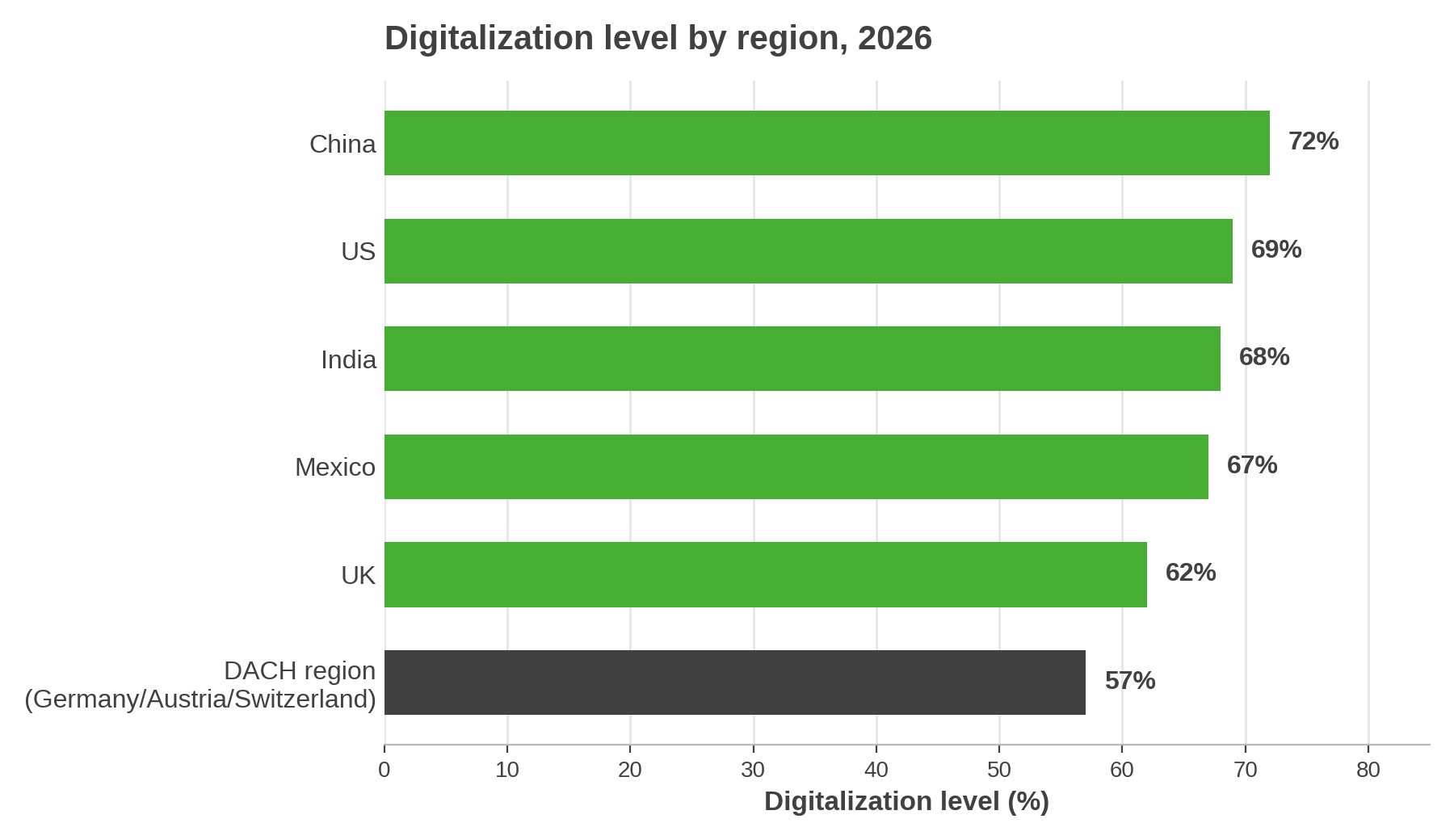
Digitalization level by region, 2026. Source: MHP / Industry 4.0 Barometer 2026.
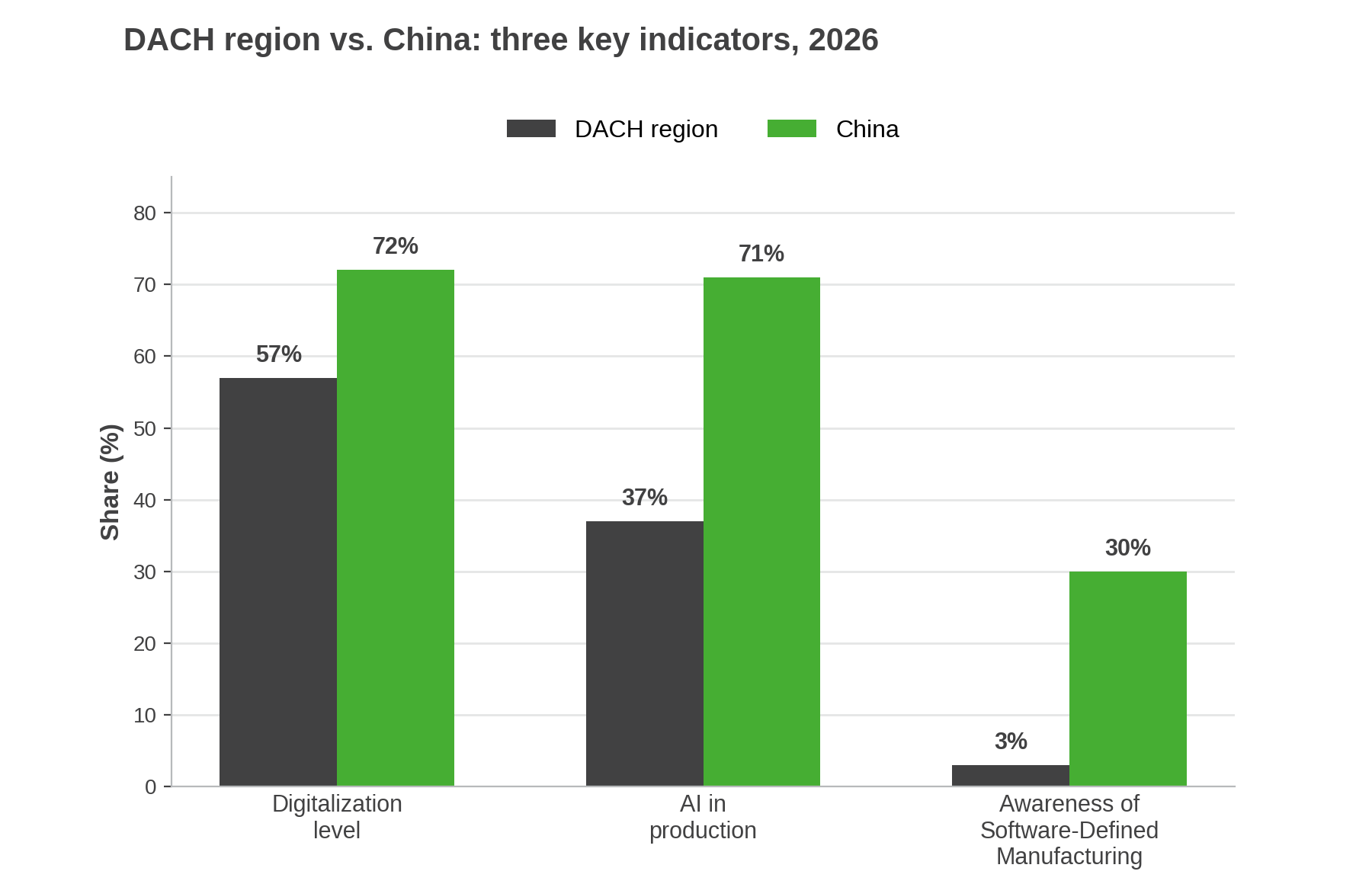
DACH region vs. China across three key indicators, 2026. Source: MHP / Industry 4.0 Barometer 2026.
Why is Europe falling behind?
The report points to familiar barriers. Similar studies find the same obstacles year after year: outdated IT systems, fragmented data, and poor interoperability between systems. In the US survey, 47% of companies name legacy systems as an obstacle. Another 39% point to data silos — information that exists, but sits trapped in systems that don’t talk to each other.
MHP CEO Tobias Hoffmeister sums it up simply: companies that fail to integrate production control, data, and software will face growing competitive pressure.
What does this mean if you’re not a large German manufacturer?
One caveat: the report doesn’t cover Sweden or the Nordics specifically. It covers the DACH region, the UK, the US, China, India, and Mexico. But the underlying problem isn’t unique to Germany, Austria, and Switzerland. Old systems, scattered data, and low investment show up across most of Europe’s industrial landscape, regardless of country.
It’s easy to read about “Software-Defined Manufacturing” and AI in production and assume digitalization means a large, expensive overhaul. In practice, it often starts much smaller. Instead of walking out to dip a tank by hand and writing the reading on paper, you see levels and trends in real time on a screen. That’s not AI-driven production. But it consolidates your data in one place, instead of scattering it across binders and memories.
A concrete first step: from manual dipping to digital visibility
Digital inventory monitoring, like SiteInfo, works as exactly that kind of contained step. It collects levels, refills, and trends in one place instead of scattered notes. You don’t need to close the entire digitalization gap at once. Every part of your inventory that moves from manual to digital counts as progress — and it’s one of the easier places to start.
Frequently asked questions
What is the Industry 4.0 Barometer 2026?
MHP (a Porsche company) and Ludwig Maximilian University of Munich published this study. Researchers surveyed 1,206 industrial companies across China, the US, India, Mexico, the UK, and the DACH region (Germany, Austria, Switzerland). The report measures digitalization levels and technology maturity in industrial production.
Why is Europe falling behind on digitalization?
The report names outdated IT systems, fragmented data, and poor interoperability as the main barriers. In the US survey, 47% of companies cited legacy systems as an obstacle, and 39% pointed to data silos. Similar structural issues show up across European industry more broadly.
Does the report include Sweden or the Nordic countries?
No. The Industry 4.0 Barometer 2026 covers the DACH region, the UK, the US, China, India, and Mexico. It doesn’t report figures for Sweden or the wider Nordic region specifically. But the challenges it describes match what other reports commonly find across European industry.
Do we need AI or Software-Defined Manufacturing to close the digitalization gap?
No. AI and Software-Defined Manufacturing sit at the advanced end of the spectrum the report measures. Most companies can close part of the gap with smaller, concrete steps instead — for example, replacing manual, paper-based readings with continuous digital monitoring.
What’s a simple first step toward digitalizing inventory management?
Digital level monitoring, like SiteInfo, is a contained example. It replaces manual tank dipping and paper logs with real-time levels, refill history, and trend data in one place. It doesn’t require a larger, production-wide system overhaul.
MCD’s editorial team researched, drafted, and reviewed this article with the support of AI tools.
Sources
MHP — Industry 4.0 Barometer 2026: Software-Defined Manufacturing: mhp.com
Control Global — MHP publishes report that China leads, U.S. accelerates and Europe lags: controlglobal.com
Metrology News — Industry 4.0 Barometer 2026 Reveals Growing Global Digitalization Gap: metrology.news