
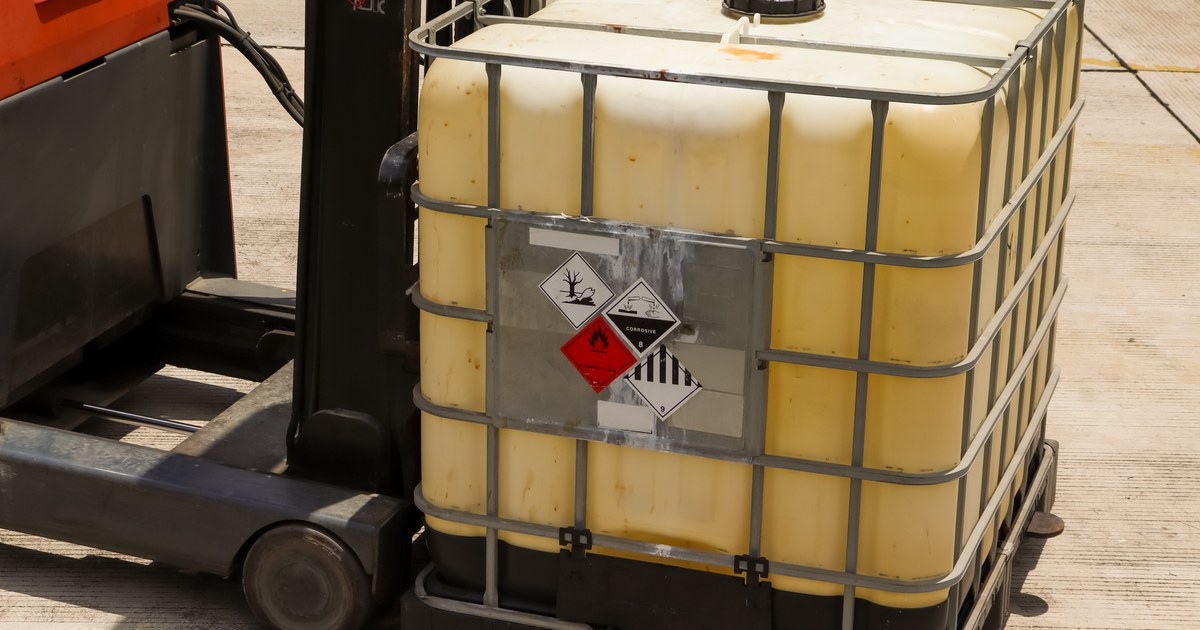
Since 12 August 2026, the EU’s new Packaging and Packaging Waste Regulation (PPWR) has applied in every member state, and it affects everything from parcels to IBCs. Across Europe, business groups describe it as a heavy burden for small companies, and some firms have even paused cross-border sales. At MCD, however, we see things differently. We are not worried. Instead, we are learning what the regulation requires and adapting step by step. In fact, we believe it can become an opportunity for our customers.
What is PPWR?
PPWR, Regulation (EU) 2025/40, replaces the Packaging Directive from 1994. Because it is a regulation rather than a directive, it applies directly in all member states, without national transposition. As a result, the same core rules now apply from Finland to Portugal. The regulation covers all packaging, from the coffee cup at the kiosk to the IBC on the truck.
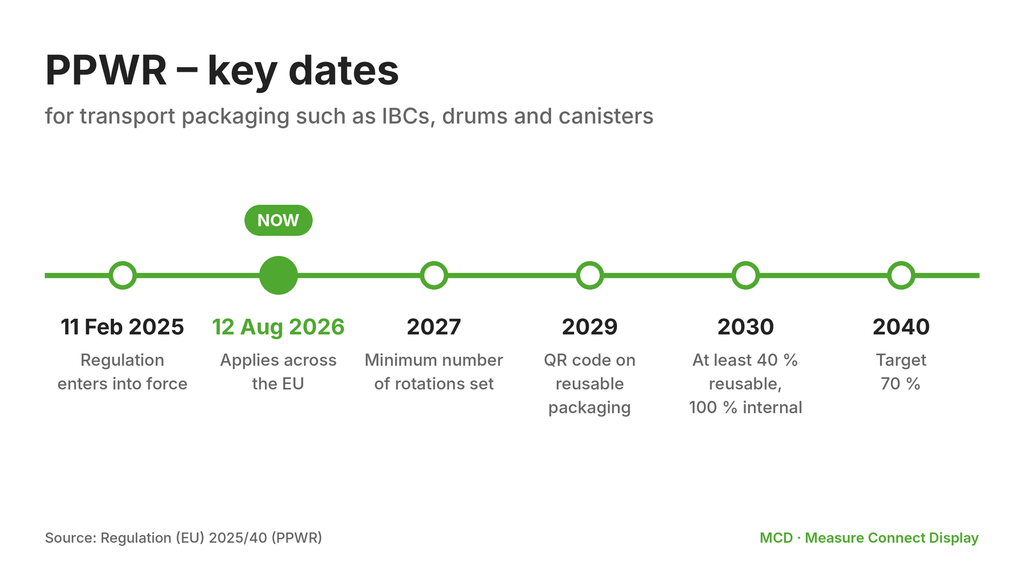
However, not everything applies at once. First, on 12 August 2026, the foundations came into force: clearer roles in the supply chain, limits on PFAS in food packaging, technical documentation and an EU declaration of conformity. After that, requirements on labelling, recyclability, recycled content and reuse follow gradually until 2040.
Why many companies are concerned
The concern is real. Nevertheless, it is mostly about administration rather than the environmental goals themselves.
- Registration in every country. Companies that sell packaged goods directly to end users in another EU country may need to register there, pay fees and appoint a local representative. For example, artists and craftspeople in Ireland have paused sales to other EU countries for this reason.
- The heaviest burden falls on small businesses. Several European business organisations warn that compliance costs in a single country can exceed the revenue from that market. In that case, companies simply withdraw.
- Late guidance. Industry groups describe the timeline as very tight. In addition, the EU had still not published several implementing acts by September 2026, for instance on producer registers and labelling.
Meanwhile, more changes are on the way. For example, the European Commission has proposed postponing the requirement for a local representative in each country until 2035, but the EU has not yet adopted that proposal. There has, however, been no general postponement of the regulation itself, so it has applied in full since August.
What PPWR means for IBCs and transport packaging
For our customers, PPWR is therefore less about parcels and more about IBCs, drums and canisters. The most important rule is Article 29 on reuse:
| Flow | Requirement for reusable transport packaging |
|---|---|
| Between companies in the EU, in general | At least 40 % from 2030, with a target of 70 % by 2040 |
| Between your own sites or linked companies | 100 % from 2030 |
| Between companies in the same member state | 100 % from 2030 |
The requirement does not stop at the packaging itself, though. A reusable IBC must also be part of a working system for return, cleaning and refilling. Consequently, buying a sturdier container is not enough. You also need to show where it is, how many times it has been used and that someone has inspected it.
Over time, traceability requirements will also become stricter. According to the plan, the European Commission will set the minimum number of rotations for reusable packaging during 2027. Then, from 2029, reusable packaging must carry a QR code or another digital data carrier. The code must give information about the reuse system and make it possible to track the packaging and count rotations.
Some packaging, however, is exempt from the reuse targets, including packaging for dangerous goods, cardboard boxes and packaging for large machinery. The exemption only covers the reuse targets, so the rest of the regulation still applies.
How PPWR affects different customer segments
How much the regulation affects you depends above all on what the tank contains and where it is going.
- Fuels. Diesel and petrol are dangerous goods, so their packaging is exempt from the reuse targets. On the other hand, ADR requirements on inspection and service life still apply, as do PPWR’s requirements on documentation and labelling.
- AdBlue and other non-dangerous products. Here, the reuse targets apply in full. Suppliers who deliver in IBCs therefore need a return flow that works and can be documented.
- Water and wastewater. Treatment plants handle many chemicals. Iron- and aluminium-based coagulants, for example, are often dangerous goods, whereas many polymers are not. As a result, suppliers will handle both exempt and covered flows, often to the same customer.
- Industry and process chemicals. The 100 % requirement applies to deliveries between your own sites and to customers in the same member state. For many companies, this will drive a shift towards pooling and rental systems where the supplier owns the IBC.
In many places, IBCs will also become sturdier, and more of them will be made of stainless steel. At the same time, this makes them more valuable. So as the number of rotations grows, loss and theft become a cost that companies have to manage.
Why we at MCD are not worried
We take the concerns seriously, but we do not let them set the agenda. Since 1983, we have adapted to new requirements for handling fuels, chemicals and the environment, and PPWR is simply another set of rules to learn. Our approach is therefore straightforward. First, we work out what the regulation actually requires. Then we follow the remaining implementing acts and adapt step by step.
We also see an opportunity. What PPWR asks of a reuse system is essentially what we already do: we measure, track and document the contents of tanks. Together with TopFuel, we are now developing a circular IBC system in which every IBC has three building blocks:
- Level measurement. We measure the contents at the customer’s site continuously. When the IBC is almost empty, an alarm triggers the next delivery.
- GPS tracking. You see the position in real time during transport, at the customer and on the way back.
- A QR code on every IBC. Each IBC gets a unique identity. The driver or warehouse scans the code at dispatch, delivery, return and inspection, and in this way links the IBC to the order in the business system.
SiteInfo, our platform, brings everything together, and every scan becomes an event. Together, these events give each IBC a digital history covering rotations, location, consumption, maintenance and order data. In other words, this is exactly the documentation PPWR asks for.
Moreover, the benefits go beyond compliance. With shorter turnaround times and fewer lost units, you need fewer IBCs in circulation. Delivery and collection can also happen in the same trip. Time-stamped scans with GPS also serve as proof of delivery. Finally, your customer never runs out, because the actual level triggers the replacement.
From concern to preparation
The 2030 targets are only four years away, but companies that start now have time to get it right. Our advice is therefore to map your packaging flows: which are dangerous goods, which move between your own sites and how many IBCs you have in circulation. Would you like to calculate what a traceable return flow could mean for you? In that case, get in touch with us at MCD.
This article gives an overview and is not legal advice. Please check your own flows against the regulation and guidance from the authorities in your country.
Sources
- Regulation (EU) 2025/40 (PPWR), EUR-Lex
- PPWR delayed? The verified answer (status 2 Sep 2026)
- Kunststoffverpackungen: Reuse requirements for industrial and commercial packaging
- ecopv: PPWR QR code requirement for reusable packaging
- Dagens PS: EU’s new requirements hit small businesses (in Swedish, 15 Aug 2026)